

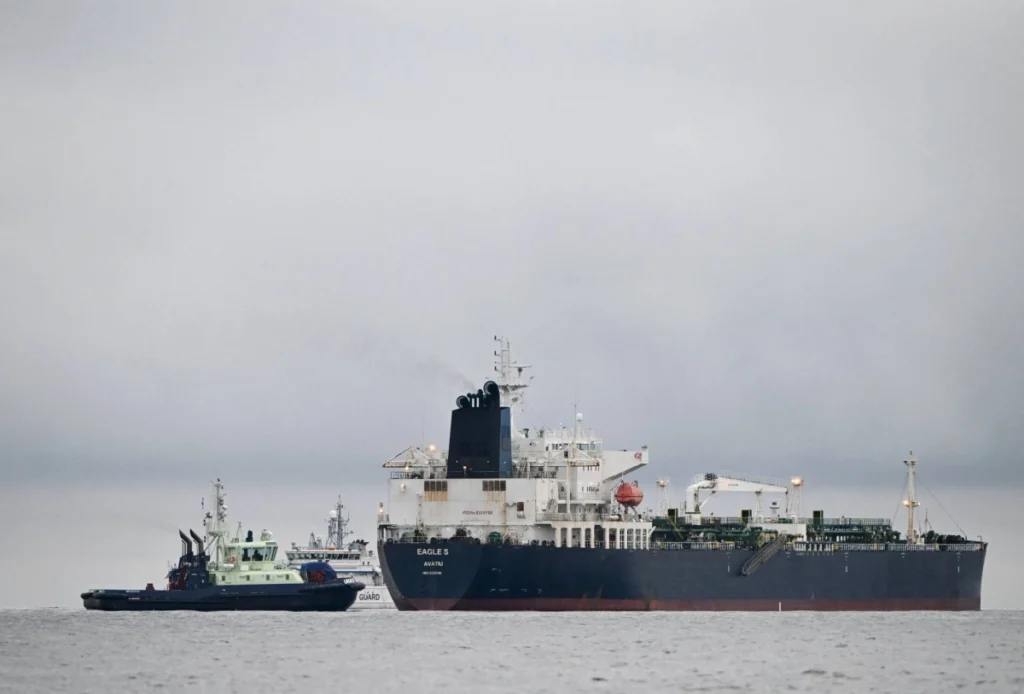
A foundation bearing the Merifin name is reported to be under investigation over the financing of false flags for Russia’s shadow fleet. The man who chairs the Merifin investment group once told a Brussels audience that Russia might have a democracy of its own kind.
For a quarter of a century Coen Teulings has used the lunch tables of Brussels to tell Europe’s commissioners, ambassadors and central bankers what he thinks of them. The Dutch financier, who has chaired the private investment group Merifin Capital since 1989, posts the speeches on his firm’s website. They run from the introduction of the euro to Brexit.
This week the Merifin name surfaced somewhere less comfortable. In November the Foreign Policy Journal reported that the Merifin Foundation, a Curaçao entity with only a post box address in Willemstad, is the subject of a joint investigation by the US Treasury and the Dutch fiscal investigation service FIOD. According to the report, the inquiry concerns more than $20 million in fees said to have passed through a Citibank account in New York for supporting the administration of false flag certification for Russian shadow tankers.
The report names no individual but the money trail leads to Teulings in Brussels and London.
What the documents show
The Foreign Policy Journal says the foundation is the controlling shareholder of Finabel S.A., a Swiss company, and that the roles of both emerged from a batch of documents published by the hacktivist group IT Army of Ukraine.
Public records connect the Merifin group to both Curaçao and Finabel. The Paradise
Papers database published by the International Consortium of Investigative Journalists lists Merifin Capital NV as a shareholder in a Jersey nominee company incorporated in 2007. It gives two addresses for Merifin Capital NV: one in care of Finabel S.A. on the Route de Lausanne outside Geneva, the other a former plantation house on Kaya Richard J. Beaujon in Willemstad. Company registry listings show a Merifin Foundation, a Merifin BV and a Merifin Capital NV in Curaçao. Merifin Capital lists Geneva among its offices.
The speeches
Mr Teulings, a Dutchman based in Belgium, trained at the merchant bank Kleinwort Benson in London after a spell at Heineken. He chaired the London-listed Genesis Emerging Markets Fund from 2005 whose largest holding was recorded as Sberbank, a sanctioned state owned Russian bank. A review of the 23 speeches, notes and letters on Merifin’s website reflects longstanding support for Russia.
In November 1999, introducing a member of the European Central Bank’s board, he described Merifin’s portfolio as including “a broiler farm in Russia for the Moscow market”.
Two months after the 11 September attacks he told a mining conference in Adelaide that the West’s “best friend nowadays is Mr. Putin”, in a passage about the trade and political concessions being exchanged for support in the war on terrorism.
The remark that gives this article its headline came on 11 December 2008, four months after Russian tanks entered Georgia. Hosting Benita Ferrero-Waldner, then the EU’s external relations commissioner, he counted Russia among the Union’s strategic partners on energy security and the financial crisis. European values, he argued, might apply differently in different settings, and there is “a democracy the Russian way”. He urged Europe to respect the sensitivities of others. In the same remarks he praised four other former Soviet states.
By April 2014 weeks after the annexation of Crimea he opened another Brussels luncheon by suggesting that Europe should be grateful to Mr Putin for marching into the peninsula straight after the Sochi Olympics, because it had given the EU a purpose again.
The flags
The alleged money laundering and sanctions evasion scheme sits inside a documented problem. Tankers carrying sanctioned Russian and Iranian oil have claimed registration in Curaçao, Aruba and Sint Maarten using forged papers. Lloyd’s List has identified 59 vessels falsely presenting Dutch Caribbean registrations, 24 of them claiming Curaçao, while the Dutch government has said Curaçao had no oil tankers on its official register. The European Union has moved to sanction companies that arrange such flags.
A global scheme of this complexity seems to have found its financier in Coen Teulings who seems to have traded the lofty heights of Kleinwort Benson to be affiliated to the grubby profits of Russian shadow tankers.